Wednesday, April 13, 2011

30 DoC: Criterion Does Racism - DO THE RIGHT THING / WHITE DOG

I was six years old when the L.A. Riots happened. I don't remember it ever being a part of my life at all. But I was nine when the O.J. Simpson verdict was announced, and I can vividly remember being ushered into the school library during the day so that the teachers could see the verdict announced live. I didn't understand why we were getting out of class, nor did I have the slightest idea who O.J. Simpson was, or why he was on trial, but I did grasp that something about this was important.

That night, after seeing the news, the world seemed a different place. That's the earliest I can remember being aware of the scale of the politics of race. I grew up in a tiny suburb without a ton of ethnic diversity, and there are a handful of incidents I can remember on the playgrounds where someone's race or beliefs or looks were singled out for persecution. It troubled me, but never to the point of defending those who were isolated and divided. I was never picked on, at least like that. I was always a part of the majority.

So, with that white male bias in mind, allow me to posit that in many ways, DO THE RIGHT THING is about something more than racism.
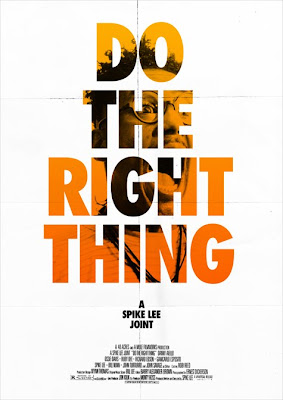

Of course, DO THE RIGHT THING is about racism, but to me, it's really about the foolishness of believing in any kind of binary system. It's a larger idea that is both incorporated and illustrated by racism.

Take the story of Love and Hate, as told to us by Radio Raheem (directly breaking the fourth wall, and cribbing from the Criterion-approved THE NIGHT OF THE HUNTER, soon to be watched around these parts). The story is a decidedly binary one, as Raheem makes the distinctions crystal clear: love and hate, two forces constantly at war in the universe. The story is left on a vague note, though. Raheem never really completes the story: he ends with the line, "If I love you, I love you. But if I hate you ..."

When Mookie screams "Hate!" at the end of the film, the significance of the story takes on a much more ambiguous note. Mookie's actions have a violent impact, and bear the trappings of hatred, but they are not borne of pure hatred; indeed, in some ways, they could be interpreted as coming from love. The story of love and hate is a far more complicated one than the narrative Radio Raheem suggests.

The title of the film also plays with the failings of binary choices. When Da Mayor tells Mookie to "always do the right thing," early in the film, Mookie laughs it off as something he's heard a thousand times before. At the end of the film, though, the simplicity of absolutes like "always do the right thing" have lost their meaning. Does Mookie do the right thing? Does he do the wrong thing? What about Sal? Or Radio Raheem? Destroying someone else's property is wrong, but what about when doing so could save someone's life? These aren't contrived choices, reality stretched and enhanced for dramatic impact, but rather the sort of excruciating choices life is made of. An action can be both wrong and right.

The greatest example of this blending of right/wrong, love/hate, is the Malcolm X/Martin Luther King, Jr. argument that runs through the film. The character of Smiley repeatedly shows us a picture of the two civil rights leaders smiling and shaking hands, which he decorates and attempts to sell to people throughout the movie. The two men are another example of two seemingly binary opposites that can actually co-exist. The film ends with quotes from the two men, King's an eloquent condemnation of violence, Malcolm X's a righteous justification of violence as self-defense. Again, it seems, an action can be both wrong and right at once.

To me, Lee seems to be saying that any kind of polarized view of the world is a false one, any world where we're given only two choices a limited one, and the film is really calling for a more nuanced and understanding view of each other as individuals.

The second feature in our Criterion-does-racism double bill, WHITE DOG, is equally brilliant.


The film examines racism through the nature/nurture argument, and examines racism as something taught, through the brilliant metaphor (and unfortunately all-too-factual reality) of 'white dogs', animals that have been trained to attack black people. When a young actress comes across one of these animals, she tries to cure it of its racist tendencies with the help of a black trainer.

I don't want to spoil things, as few people will have seen this particular film, given it's limited release, but it verges into surprising, yet inevitable territory. It's a brilliant depiction of the differences between human and animal, of the violence at the heart of survival, and it gives us one of the most fascinating villains in cinematic history.

Both of these films stuck with me, long after they were finished. They took me back to that little boy, watching Johnnie Cochrane on that tiny television, sitting on the library floor, and how much larger the world has become since then.

Monday, April 11, 2011

30 DoC: 8 1/2 and Mel Brooks

A while ago, I wrote about how you can connect RAGING BULL in one step to SPACE JAM (seriously). In that same entry, I also suggested that RAGING BULL might be the best-looking black-and-white film ever made.

I might have to eat crow on that one, because 8 1/2 is ridiculously gorgeous.


I'm not the world's biggest Fellini fan, but GODDAMN:


And all of these images take place within the first five minutes of the film!

8 1/2 is justifiably praised for its lush cinematography, its brilliant post-modern analysis of the filmmaker and the film, and for all of the things that make film profs feel tingly inside. Those are all valid reasons, and I love them too, but for me, it's the humour in 8 1/2 that truly sets it apart.

The cliche of older foreign films being sombre, highbrow examinations on death and misery gets shown the lie here: 8 1/2 is steeped in sex, jealousy, and lust, and it's often riotously funny while it does it. The "harem" dream scene is a mini-masterpiece within a masterpiece, lampooning male desire in a scene that wouldn't be too out of place in a Mel Brooks film.

Of course, comparing Brooks to Fellini is a little facetious of me, but not as much as it may seem. Brooks gets a dismissive shake from the the elitists as "the fart guy", and I'm sure there are those who would argue he is more closely linked to say, the Wayans, then Fellini, but his films are brilliant skewerings of racism, scientific rationality, and politics. I mean, he even shot a black-and-white film!

So Criterion, where's the Blu-ray of YOUNG FRANKENSTEIN?

Kidding. Kind of. That'd be totally awesome, though.

Friday, April 1, 2011

VALENTINE'S DAY: By The Numbers

I once jokingly referred to VALENTINE'S DAY as the Remembrance Day of movies.


I had no idea how right I was.

I worked in a movie theatre during VALENTINE'S DAY's theatrical release, and on the day in question, a huge fight broke out between two ladies over a seat dispute. There was name-calling and hair-pulling, and an eventual escorting of people from the theatre. Ever since then, I've been intrigued to discover if VALENTINE'S DAY had the sort of power that could compel two rational people to fight over a seat.

Well, those people were just idiots. This is a miserable excuse of a movie, all the ideas stolen from other, better films. So in the spirit of the script of VALENTINE'S DAY, allow me to break down the film by the numbers, Erin Brockovich style!

-1
the number of times I would watch VALENTINE'S DAY again.

0

the number of lines Ashton Kutcher is able to deliver with emotional sincerity.

1

the number of times VALENTINE'S DAY surprised me.

2 for 1

the deal the production seemed to score on Roberts actresses.

4

the number of times I considered just watching LOVE, ACTUALLY instead.

8
the number of times the words "I hate Valentine's Day" are spoken or written in the film. At least. But wait - how many times are the actors actually saying "I hate VALENTINE'S DAY"? These are the questions your brain ponders to help you make it through the film.

10
the number of years that the Taylors, Mr. Lautner and Ms. Swift, should be sentenced to some sort of acting prison for their incredibly irritating performances. Each.

90
the number of minutes I thought this film would last.

122

the actual excruciating number of minutes this film lasted.

Thursday, March 31, 2011

I SAW THE DEVIL And It's Really Lame

This is an apology.

I've only ever walked out of one movie in my lifetime, and it happened when I was eleven years old. One summer day in 1997, my pre-pubescent mind just couldn't handle the ridiculous kangaroo-samurai of WARRIORS OF VIRTUE, and refused to tolerate it for one more minute. I headed to the lobby to eat my peanut butter cups in peace and wait for my dad and brother. This seemingly simple act had two complex, long-lasting effects on my impressionable young mind: one, witnessing the magic of slacker movie theatre employees shoot the shit about movies while all the theatres were in and they had nothing to do can probably be directly correlated to my working in movie theatres for the better part of a decade; and two, in the days and months to come, I began to suspect that maybe I had missed ... something ... by walking out of WARRIORS OF VIRTUE, something ill-defined but valuable, and I resolved to never walk out of a film again (a later viewing of the specific film in question during my twenties did nothing to definitively prove this notion, at least as it relates to the kangaroo-samurai genre).

Of course, I've come close to walking out of films since then: I've written about my disdain for Clint Eastwood's GRAN TURINO before, one of my favourite whipping-boys, and there have been some truly regrettable experiences that refuse to leave my cinematic memory, from KICKIN' IT OLD SKOOL to ACROSS THE UNIVERSE. On the search for new, exciting films, you're bound to find a few that don't speak to you. That's just part of the gamble. I suffer through these films with a certain begrudging acceptance, in a sort of unspoken pact with the movie gods that this is just the way it goes, sometimes.

But when I see a film like I SAW THE DEVIL (AKMAREUL BOATDA), I get angry.


I bemoan films like GRAN TURINO or ACROSS THE UNIVERSE because of the tremendous amount of skill and talent that went into making these films, all in service of hackneyed ideas (as opposed to a work like KICKIN' IT OLD SKOOL, which is just a cinematic abortion from frame one). I SAW THE DEVIL firmly belongs to this category. It's a tremendously polished and affecting film, plunging you into an incredibly disturbing serial rapist/killer story and never really letting you go.

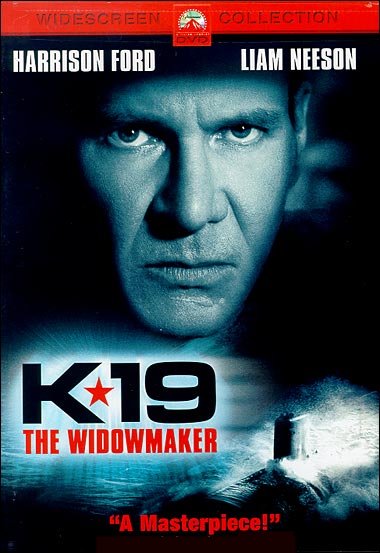
"Harrowing" is an overused word, especially in film. Splashing any word on the cover of K-19: THE WIDOWMAKER will rob that word, whatever that word is, of some of its power. But I SAW THE DEVIL is harrowing in the true sense of the word. It's beyond hard to watch, its violence graphic and sudden, shocking even to jaded viewers. It got underneath my skin, and such power has to be commended. If visceral reaction was the only merit on which we judged film, I would applaud I SAW THE DEVIL and urge you all to see it.

But viscera is not the only criteria on which we should judge film. Film should serve a higher purpose than that. I SAW THE DEVIL does nothing with its incredible power. It is more than content to play out a seemingly never-ending string of horrifying scenes in front of you, then make a half-hearted, cynical attempt to make this a story about how becoming a monster to stop a monster will ruin more lives than it brings justice to. If memory serves, no less than three characters have a line to that exact effect, using a sledgehammer to drive home thematic ideas when it's been using a scalpel for everything else. It's a film that gives the viewer tremendous credit, except when it comes to the big stuff. It's bereft of ideas, or at least ideas beyond a higher plane of cool and or bloodcurdling ways to kill people.

I'm not going to pretend that my criticism of this film isn't rooted in moral outrage. This film offended me. I'm not against displaying the horrors that humanity is capable of, but there has to be a reason for putting those things on display for me. It's the reason I have a problem with the bulk of the horror genre, or at least the sections of it that isn't straight-out exploitative outrageousness (PIRANHA 3D) or has larger social implications (FRAILTY, THE THING). The director of I SAW THE DEVIL, Jee-woon Kim, previously made THE GOOD, THE BAD, AND THE WEIRD, a film that I loved, so maybe I'm not seeing something. Feel free to open my eyes with comments below.

When the film was finally over (I think even the most strident fan of this film would have to admit that you don't need 147 minutes to tell this story), I was getting up to leave and overheard the man in front of me mention something about how great the film was. It was a viewpoint I couldn't understand, had no sympathy for nor had an interest in exploring, and I left the theatre and went home without saying so much as "goodbye" to the friends I had come to the theatre with.

So to those friends, sorry I left without talking to you. It was the closest I could get to walking out on the movie. Why don't you come over one night and we'll watch WARRIORS OF VIRTUE together?

Monday, March 28, 2011

THE WOLFMAN Should Have Been Called JOE JOHNSTON'S MARK ROMANEK'S FRANCIS FORD COPPOLA'S THE WOLFMAN. But I Get That That's A Bit Unwieldy.

The recent Benicio del Toro remake of THE WOLFMAN has one of the more interesting production histories in recent years, with director Mark Romanek bailing just three weeks before the shooting was to begin and Joe Johnston (of JUMANJI and THE ROCKETEER fame, and the forthcoming CAPTAIN AMERICA: THE FIRST AVENGER) stepping into his shoes at the almost-last minute. Romanek left over the always dependable "creative differences", but things seem to have worked out well for him, as he went on to make NEVER LET ME GO, one of the finest films of last year. How did THE WOLFMAN fare?


Not so well. Perhaps predictably, this movie is a mess, a mishmash of ideas and styles that never forms into a cohesive whole. What is more surprising is the blatant stylistic lifts from Francis Ford Coppola's BRAM STOKER'S DRACULA, which might be the only film in history to possibly have more apostrophes than words in the actual title. I'm sure Johnston had minimal time to prep his version of THE WOLFMAN, but everything from the sped-up wolf-vision camera, to his use of long, creeping shadows, to the secret garden labyrinths, is a direct lift from Coppola's film.

So with so many similarities, let's explore some of the reasons why THE WOLFMAN falls so short of it's stylistic predecessor:

Anthony Hopkins is no Anthony Hopkins


The clearest link between the two films, aside from their gothic monster-movie origins, is the presence of veteran actor Anthony Hopkins. Unfortunately, THE WOLFMAN doesn't have the right Anthony Hopkins: it has THE RITE Anthony Hopkins, a decrepit shadow of his former self. Hopkins has been typecast as Hollywood's go-to creepy old guy ever since SILENCE OF THE LAMBS, and he seems remarkably fine with it. Occasionally he'll turn out a THE FASTEST INDIAN or something, but I kind of picture him sitting in some sort of spiky black tower, cackling to his orc henchmen as royalty checks for RED DRAGON and FRACTURE pour in.

Here, he's doing nothing new, occasionally lifting an eyebrow or smiling enigmatically, and you get a glimpse of the mischievous actor peeking out underneath the fatigue of playing the same role over and over. They're fleeting moments, though, few and far in between. In DRACULA, his Van Helsing is a fascinating enigma, a presence that constantly demands your attention. Where has his fire gone?

Emily Blunt is no Winona Ryder


Somehow, I've made it through my entire adult life without someone forcing me to watch THE DEVIL WEARS PRADA, so I first saw Emily Blunt in SUNSHINE CLEANING. To my mind, she's never been better. Every role I've seen her in since has been an excuse to look sort of sullenly off camera and be delicately vulnerable. Her character is severely underwritten in THE WOLFMAN, but she doesn't add anything to it, either.

Look at that picture: Winona's gonna mess you up. Emily's auditioning for a role in THE VILLAGE 2: CRAZIER WHITER PEOPLE. There's no comparison.

This Gollum-Thing is no Monica Bellucci


Monica Bellucci rising up between your legs as some sort of busty succubus vampiress? That's scary hot. Smeagol doing the same thing? That's neither.

And neither is this movie.