Showing posts with label Thirteen Days. Show all posts

Friday, March 18, 2011

Why Gandalf Is A Dick, And What It Means About The Cold War

I recently spent some time in rural England, and walking around the endlessly lush countryside of that nation, you can't help but feel some of the magic of it's rich history. Every coastal area has an abandoned World War Two-era radar station, and you can faintly see the outlines of the kings and tribal warlords of the past, leading armies over the dales. It's more than just the stuff of history books, though; you occasionally top the crest of a hill and feel an Arthurian presence, a sense that you're connected to the legends and myths of the past, a feeling of reaching through time.

So of course, as soon as I got home, I threw on THE LORD OF THE RINGS.


Twelve hours later, I started thinking about something that I had never really taken notice of before: the fact that Gandalf is a huge dick.

There are elements of Gandalf's dickish behaviour as early as "The Fellowship of the Ring", where he gets off on withholding the joy of fireworks from little children, or mocking Bilbo's lame smoke rings, or in his constant berating of Pippin, but his full douchebaggery only really reveals itself with his transformation to Gandalf the White, in "The Two Towers".

That's when his reincarnated ass shows up, does a little Saruman impression just to fuck around with his best friends, mutters a bunch of alarming shit like "the veiling shadow that glowers in the East takes shape", proceeds to do nothing to stop humanity from entering a giant trap, and then takes off just as the single most important battle in the world is about to begin, abandoning the task of protecting the world of men to twelve year-old boys.

Now, technically, he's going out to gather reinforcements, to bring back the banished horsemen of Eomer, but really, why does he have to go? Why can't one of those twelve year-olds run out on horseback and bring them back? "Oh, Gandalf has Shadowfax, the Lord of Horses," I hear you saying. "Only he could go get the Rohirrim and bring them back in time to save Helm's Deep." No. No. That's bullshit. If Shadowfax is the Lord of Horses, and can both understand humans and communicate with other horses, why can't Shadowfax just go get the goddamned Rohirrim? Hell, that way, we don't even have to spare the twelve year-old. He can help 'man' the gates. Meanwhile, Gandalf could be using his magic flashlight and/or one-time bubble shield powers to help defend humanity. But before hundreds of boy soldiers can even start to learn the subtleties of barracks humour, let alone the intricacies of swordplay, Mr. the White is off, on a mission that literally almost anyone else could do. I won't go so far as to call him a coward, but by leaving at the worst possible time, he's clearly a dick.

Okay, so what? What can we learn from Gandalf the Jerk? A surprising amount about the Cold War, I think.


Tolkien would decry those who look for historical parallels in his magnum opus, but just as surely as they were not intended, they could not be avoided. Every work is shaped by the time in which they are created, by the concerns of a society and the individual experiences of their authors, not to mention the interpretations of the audience.

So if post-WWII readers would read the descriptions of women huddling around their children in the Helm's Deep sequence of "The Two Towers" as echoes of the Blitz, or modern audiences see the film version of it as an echo of American civilians comforting each other on 9/11, or of innocent Iraqis surrounded by the bombing of Operation Iraqi Freedom, who's to say they're wrong? They're all valid interpretations.

So without talking about what Tolkien intended, how would a post-WWII Soviet reader see Gandalf's abandonment of the people of Rohan? That's mostly a hypothetical question, as the USSR banned the book from being published, seeing it as a "hidden allegory 'of the conflict between the individualist West and the totalitarian, Communist East'". So we know the censors saw at least some of themselves in Sauron, which is a psychologically interesting self-identification, but I think the Soviet people would have seen more of themselves in Rohan, a nation abandoned by all of its allies to face the wrath of their enemy, alone.

There are clear parallels between Stalingrad and Helm's Deep, and in this light, Gandalf's abandonment would carry Yalta-like repercussions, an act that the Soviets took as a betrayal and greatly furthered the animosity that would eventually lead to the Cold War, nuclear proliferation, and the closest this world has come to total annihilation. Thanks Gandalf, you absolute piece of shit.

Of course, in the book and film, Gandalf comes back with the Rohirrim (leaving it until the last second, of course) and helps save the day. In real life? Uh, not so much. The Allies left Russia to bleed the Germans while they carefully prepared for the Western front. In this light, then, "The Lord of the Rings" can be read as a sort of anti-Cold War parable about how the West ruined its chances to create a lasting peace. In fact, the later conflicts in "The Return of the King", where the men of Minas Tirith are saved by the very Rohirrim they did not come to the aid of in the earlier book, plays like a fantasy of how the post-war period could have evolved.

The word 'fantasy' is not to suggest that Tolkien was a naive idealist: "The Lord of the Rings" is full of descriptions of the corruptibility and weakness of humanity. But perhaps more than orcs and goblins, wizards and magic rings, the greater fantasy of Tolkien's is in the hope that humanity can put aside our ambitions for power and status in favour of peaceful co-operation. That would be greater in every sense of the word.

Now, if you'll excuse me, Gandalf is terrorizing an entire village, including women and children, with apocalyptic fireworks shaped as dragons. What a dick.

Monday, February 21, 2011

Fetishizing the Past: History, Nostalgia and the Mad (Anchor)Men

I've been catching up on my television watching as of late, and one of the shows I'm finally giving a chance is AMC's "Mad Men". I know, I know. I'm pretty late to the party. But there's a good reason for that.


Every time I would hear about "Mad Men", I'd ask what it was about, and the response would inevitably come back with some variation on, "It's about the sixties ... and smoking ... and sexually harassing women ... and looking awesome in a suit." Well, I would think to myself, I would rather watch THE WIRE eight hundred times in a row than watch that. Then I'd sit back in a smug, self-satisfied way, and convince myself that THE WIRE is the finest piece of American television ever made. Which, to be absolutely clear here, it is.

However, "Mad Men" wouldn't go away. More and more people were talking about it. I started hearing things that intrigued me, like the main character not being who he said he was. I saw a picture of Christina Hendricks and unconsciously did a "Mary Steenburgen in Back to the Future III" impression: golly! And then I heard about the storyline tying into events like the Cuban Missile Crisis.

Now, I haven't got there yet, having only reached episode six of the first season, but this is what truly excites me about this show (or at least this show's potential): I'm a history nerd. I will confess to owning THIRTEEN DAYS. I bought Soderbergh's CHE films, sight unseen. Hell, I own AND STARRING PANCHO VILLA AS HIMSELF, a made-for-HBO movie I had to write an essay on for a history elective and ending up buying because I thought it was so swell. I mean, Antonio Banderas as the legendary Mexican revolutionary? Colm Feore as D.W. Griffiths? Amazing!

I realize few people would echo those exact sentiments (for example, I feel like laughter at Mr. Banderas' casting would be a more common reaction), but I think many people have the same general response to period pieces: a fascination with the past. How else would you explain the enduring popularity of "Mad Men" in spite of the show's lackadaisical pacing?

BAM! Complisulted!

I kid. I haven't watched enough of "Mad Men" to really make an informed judgment yet, but I will say that the first six episodes of HBO's period-piece-response "Boardwalk Empire" has me far more interested in its sprawling story and compelling characters. So far, "Mad Men" is less about any of those things than it is about the fetishization of period details: stainless cigarette lighters, crisply ironed white dress shirts, and the smooth curved lines of bourbon glasses. It's no coincidence that the beautiful DVD packaging of the show features these objects, instead of the characters. At this point, the "smoking... sexual harassment...suits" criticism is bang-on. Not to say that it can't become more, but six episodes in, that is what "Mad Men" is about.

My apologies to everyone who told me that and saw me roll my eyes. You were right.

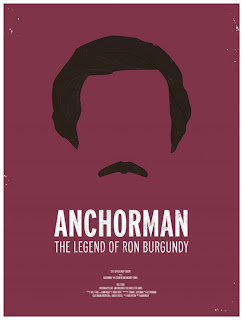
However, when I watched ANCHORMAN: THE LEGEND OF RON BURGUNDY yesterday, I started wondering where this reverence for the past comes from.


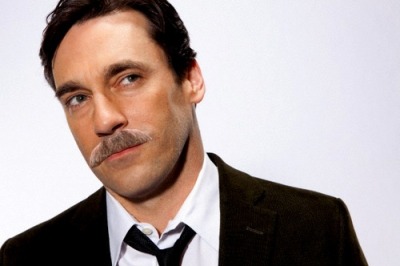
ANCHORMAN and "Mad Men" may not seem the most compatible of entertainments, but once you get past their tonal qualities, they do share a great deal of similarities. In fact, "smoking, sexual harassment, suits" might as well be Ron Burgundy's personal motto. The only noticeable difference between him and Don Draper is the horrifying moustache.

The similarities go beyond the protagonists, though. There is a sense of deep-rooted affection for the entire world that goes beyond a love of character or place: both of these works are in love with the past itself. Of course, the tone in ANCHORMAN is a much more comedic look at the excesses and political incorrectness of the 1970s, but there is a warmth to the innocence of the era that permeates the film.

I guess the word that most defines what we're talking about is nostalgia, and what makes these works so relatable is that everyone experiences nostalgia. It's not so much the specifics of the memory, but the feeling that the act of remembering something evokes. So while none of us (I assume) worked in the advertising agencies of '60s America, or have ever seen a news broadcast from the '70s, we can relate to it, because it feels like we're remembering it (even though we've never actually experienced anything like it).

But why would we want to do this? Why would we want to relive things we haven't lived through in the first place? I think the issue at the heart of nostalgia is that we know how fragile (and important) history is. History is how we construct narratives in every facet of our lives, and without narratives, it's exponentially more difficult to arrive at a truth. Just ask that crazed genius, David Lynch.

BAM! Complisulted!

I kid. But I do think that the reason Mr. Lynch has never dabbled in the historical film genre may be that he's not interested in cinematic meaning deriving from narrative, but rather from mood and emotive qualities. However, on both a personal and societal level, we're constantly examining why we got where we are and how we got there, forming narratives to help us understand. Therefore, memory, both personal and cultural, is one of our most cherished possessions.

And that's why we fetishize the horrifying moustaches and gleaming cigarette lighters of our past: they all tell us something about who we were, where we've come from. It's why we can enjoy Will Ferrell screaming at us for an hour and a half. He's a reflection of us, a chubby, hairy signpost of our history.

And it's why I'll give "Mad Men" some more time to impress me. At least until the Cuban Missile Crisis kicks in. Now who's up for a little THIRTEEN DAYS?

No one? Oh. Okay.